


The spreadsheet trap: Why you need a SaaS spend management tool
December 23, 2025
12 minute read
Let’s be honest: managing your company’s software subscriptions today feels like trying to keep track of a thousand bouncy balls at once. Every team is dabbling with GenAI apps, constantly renewing contracts, and changing usage every day. While all this technology powers your organization, trying to track it manually is completely overwhelming, and you still don’t know where your budget is going. This complexity is why you need a SaaS spend management tool.
Many IT and finance teams start (and often stop) their tracking journey with an old, trusted friend: the spreadsheet. In fact, according to 2025 research, 40% of organizations still track renewal dates manually on calendar or spreadsheet.
Excel and Google Sheets are fantastic for so many things, but when it comes to the real-time, dynamic world of hundreds of SaaS apps, they simply can’t keep up. Relying on a static spreadsheet is a trap, giving you a false sense of control while costs still creep up, licenses sit unused, operational inefficiencies remain, and vital security details get missed.
The truth is this: you need a software partner that works as fast as your SaaS environment. With the average organization using over 106 SaaS applications, tracking it all manually is simply impossible, which is precisely why you need a SaaS spend management tool.
A dedicated SaaS spend management tool is that partner. It’s not just about cutting costs; it’s about giving your team the power to automate the busywork, optimize every single dollar, and finally feel confident about your tech investments.
Let’s dive into the true cost of managing SaaS manually and explore how a dedicated tool can change everything.
The growing SaaS challenges without proper management
Before we talk about solutions, we must recognize the size of the challenge. The sheer volume and speed of modern software acquisition have created a level of complexity that simply didn’t exist a decade ago.
It’s not just a few big programs anymore; it’s hundreds of apps, contracts, and vendors. Consider the huge number of licenses that require usage tracking and diligent attention. The escalating financial risk is just one more reason why you need a SaaS spend management tool now more than ever.
A never-ending explosion of SaaS and Shadow AI tools
The first challenge is simply the number of tools. If you feel like your software count is constantly changing, you’re right! Thanks to easy online sign-ups, teams can acquire new tools in minutes.
This decentralization leads directly to Shadow IT, software purchased and used without the central IT team’s awareness. It’s a huge problem, and it’s becoming even more complicated with the sudden popularity of AI tools. In fact, according to the BetterCloud State of SaaS 2025, 95% of companies already use at least one AI use case. Employees quickly sign up for AI writing, summarization, or design tools, often without vetting the terms, security, or overall cost.
This rapid, unmanaged expansion means that any attempt at SaaS asset management using manual methods is doomed from the start.
Hidden costs and unnecessary waste
Lack of central visibility creates an environment where waste thrives. Without a dedicated license management software, you’re guaranteed to lose money in three primary ways:
- Shelfware (idle licenses): These are licenses you pay for but that sit “on the shelf” because the user left the company, changed roles, or simply stopped using the tool. Since a spreadsheet can’t tell you the last time a user logged in, you keep renewing the expense.
- Overlapping apps and licenses: This happens when different teams buy different software for the same functions, like five different project management tools. You pay for redundant features, and your internal collaboration suffers.
- Tier mismatch: This is paying for a “Pro” or “Enterprise” license when a “Basic” or “Standard” plan would easily cover the user’s actual needs. You are simply overspending for unused capacity.
Gartner maintains that companies without some kind of SaaS spend management tool like a SaaS management platform annually waste about 25% of their total SaaS budget. These quiet, hidden costs can easily represent that much or more of your annual SaaS budget.
The critical need for visibility
Ultimately, the biggest challenge is the lack of visibility. When you can’t answer basic questions, you can’t effectively manage costs. Can you answer questions like:
- How many apps and licenses do we own?
- Which user hasn’t logged in for 90 days?
- When is that crucial vendor contract up for renewal?
If not, it’s a telling sign why you need a SaaS spend management tool. You need automated discovery and usage telemetry to bring all those decentralized licenses, contracts, and usage metrics into one central source. This is the foundation of truly effective SaaS asset management. Without it, you’re just guessing, and guessing in business almost always leads to overspending.
New financial superpowers: go from cost center to profit center
Now that we have a solid understanding of the challenges, let’s look at the exciting part: how a dedicated tool transforms those challenges into clear financial benefits.
This section is all about getting the biggest possible bang for your software buck. This cost-saving potential is the strongest proof yet for why you need a SaaS spend management tool.
Stop paying to get nothing: automatically eliminate waste
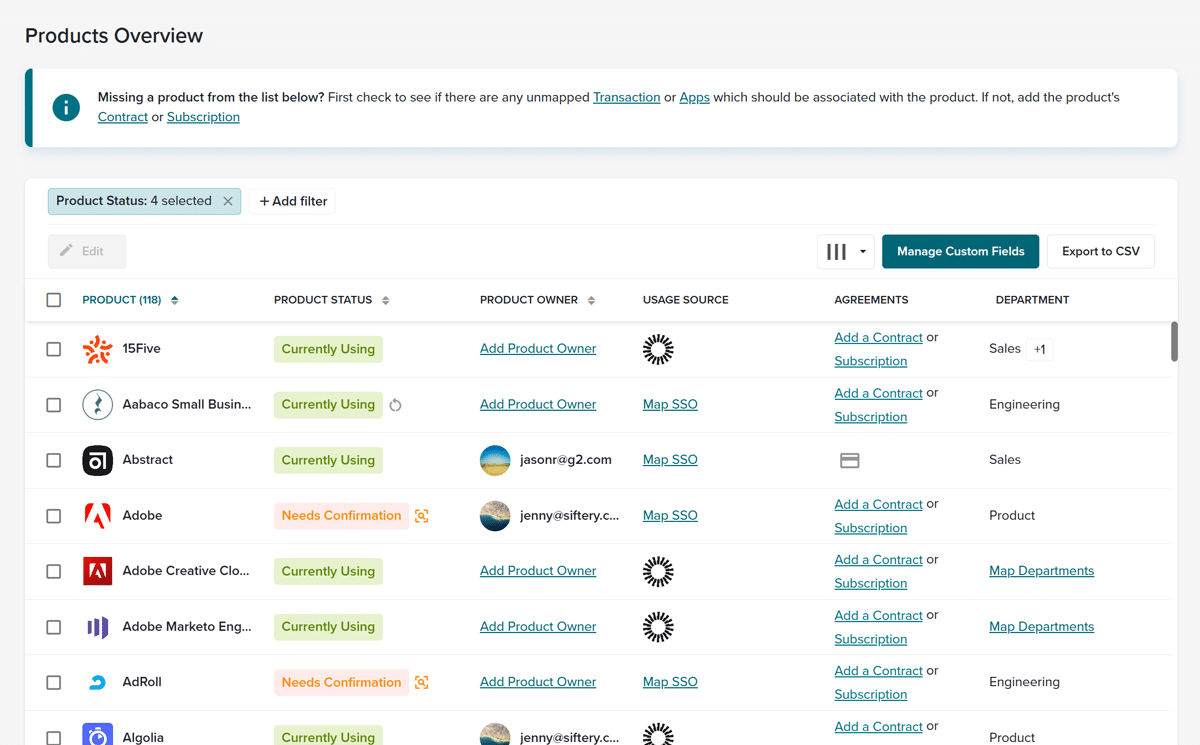
The very first step to optimization is getting rid of the “shelfware” we talked about. A basic license tracking software can only show you who has a license; a true SMP with SaaS spend management capabilities identifies who is not using one.
By continuously monitoring login and activity data, the tool flags licenses that are ripe for reclamation and then automatically reclaims them according to the rules you give it.
You can set rules—for instance, “If a user hasn’t logged into the CRM for 60 days, notify their manager and queue the license for deactivation.” This automated, data-driven approach means you are constantly optimizing, ensuring every dollar spent is on software that is actively delivering value.
Track your vendor contracts and contract end dates with ease
When you manage dozens of apps, contract end dates are easy to miss—and missing a renewal window means losing your leverage. A modern SaaS asset management solution solves this by acting as your central contract repository for strong vendor management processes. It doesn’t just store the PDF; it extracts key data points like termination clauses, auto-renewal dates, and price ceilings.
Crucially, it sends automated, proactive alerts well in advance of the renewal deadline. This ensures your team always has plenty of time to review usage data, explore alternatives, and prepare a strong negotiation strategy.

Become the smartest negotiator with data-driven renewal leverage
Imagine walking into a vendor renewal meeting armed with flawless data – with plenty of time prior to the contract renewal date.
That’s the power of SaaS spend management capabilities within an SMP.
Instead of guessing, you know precisely how many features your company utilizes and what your true usage threshold is. If the vendor tries to push a costly renewal, you can counter with hard data showing that 15% of your licenses are currently dormant. This level of detail transforms you from a passive buyer into a powerful negotiator.
In total, by tracking historical usage trends and upcoming contract end-dates, the tool provides predictive insights, helping you budget confidently and avoid last-minute budget surprises.
Rightsize for license optimization
This is the nuts-and-bolts function where the savings truly accumulate. A comprehensive license management software allows you to automatically implement smart policies. You can automate downgrades for users who don’t need premium features (e.g., changing a basic employee’s Zoom license from Pro to Free). Conversely, you can make sure premium license use is continually maximized.
For apps where usage fluctuates, the tool helps you manage a pool of licenses, dynamically assigning and revoking access to maximize utilization and minimize cost. This efficient license use is often the fastest way to achieve substantial ROI.
Prove your worth: calculate and boost your true SaaS ROI
Ultimately, the goal of using SaaS spend management functions in an SMP is not just to cut costs—it’s to ensure your software spending truly helps the business grow. By linking usage data to departmental spending, an SMP helps you calculate the ROI of your software investments.
Are sales licenses sitting unused after a pricey CRM upgrade? Does the marketing automation tool drive real user engagement? When you can answer these questions with data, you can make smarter strategic decisions about where to invest and where to divest, turning your tech stack into a genuine competitive advantage.
Beyond the software budget: Compliance, security, and efficiency
We’ve established that a SaaS spend management tool is a financial lifesaver, but its benefits stretch far beyond the budget line. It’s also one of your most powerful tools for maintaining a strong security posture and boosting operational efficiency across the IT department and entire organization.
Meet regulatory compliance with confidence
In today’s regulated environment, managing access to sensitive data is non-negotiable. Whether you deal with HIPAA, GDPR, or SOC 2, you need verifiable proof that only authorized personnel have access to certain applications and data.
As every security and IT professional knows, trying to audit access controls manually across dozens of vendor portals is a compliance nightmare.
A SaaS spend management tool provides a centralized view of all user access, permissions, and security configurations. This makes it infinitely easier to quickly generate never-expiring audit reports and prove that governance policies—like enforcing least privilege access or restricting access to certain regions or user groups—are consistently followed across your entire tech stack.
Eliminate security risks through smart SaaS asset management
Unmanaged assets are common security risks, plain and simple. Every Shadow IT application represents an unvetted entry point that could compromise your corporate IT resources or expose sensitive data.
The continuous discovery feature within an SMP’s SaaS spend management functions is your first line of defense. By shining a light on unapproved applications, you can quickly assess risk level and either sanction them with proper security settings or decommission them entirely.
Finally, automating critical tasks like offboarding ensures security is never compromised. When an employee leaves, the tool automatically revokes access to all SaaS accounts, eliminating the dangerous window where a former employee could still access corporate data.
Elevate the software asset manager role through automation
We already discussed the time wasted on manual audits, but the benefits of automation extend into daily IT operations. Tasks like license reclamation, file sharing permission management, basic user setup, and permissions adjustments become click-to-automate workflows instead of repetitive, time-consuming tickets – dropping the time savings straight to the bottom line.
By removing the administrative busywork, the tool elevates the role of the software asset manager and IT team. Instead of spending their day buried in error-prone, outdated spreadsheets, they can focus on high-value, strategic initiatives like AI.
Streamline operations and improve IT-Finance collaboration
The benefit of a single, trusted source of truth goes far beyond individual departments—it streamlines the collaboration between IT, Finance, and Procurement.
No more manual back-and-forth: IT doesn’t have to email finance for expense reports, and finance doesn’t have to chase IT for usage data to justify a renewal. The SMP’s SaaS spend management functions provide a shared operational platform with synchronized data on cost, contracts, and usage. This unified visibility cuts down on friction, speeds up decision-making, and creates a collaborative partnership where IT and Finance work together seamlessly to maximize technology investments across the entire company.
The combination of cost savings, security, and compliance makes clear why you need a SaaS spend management tool for holistic risk management.
Real-world SaaS spend management results and implementation tips
Moving from a manual spreadsheet system to a powerful SaaS spend management tool is a significant step.
To help you envision the change, let’s look at what real success looks like and how you can get started smoothly. The proven ROI clearly demonstrates why you need a SaaS spend management tool for scaling growth.
See proof in the numbers: short customer stories
Across various industries, companies are using SMPs to drive massive efficiency and savings. Here are just a few scenarios:
- A mid-sized tech company: A global software firm discovered they were paying for 450 unused licenses across five major applications due to slow offboarding. By automating license reclamation, they saved $150,000 in the first six months.
- A financial services firm: The compliance team was spending 10 days preparing quarterly access audit reports. With the centralized visibility of their SaaS spend management tool—an all-in-one SMP—they reduced that reporting time to under an hour, freeing up valuable staff time for critical security initiatives.
- The E-commerce retailer: After identifying three highly overlapping project management applications, the Procurement team was able to consolidate their spending and use the detailed usage data as leverage. They negotiated a 20% discount on a single, preferred vendor contract, saving $60,000 annually while moving to a more premium service tier.
How to choose the right tool
Not all tools are created equal. When you are ready to evaluate solutions, look for platforms that prioritize five core capabilities in a unified platform:
- Full discovery: The tool must integrate with every possible source—SSO, finance systems, and expense management—to guarantee total visibility of your entire application stack, including Shadow IT and Shadow AI. It also should present them in a single, unified dashboard.
- Strong automation capabilities: Look beyond simple license tracking software. Can the tool automatically execute actions like license reclamation, downgrades, file access, and offboarding workflows? The less manual work, the higher your ROI.
- Data protection capabilities: More than simply software asset management software, the best SaaS management platforms provide data loss prevention (DLP) capabilities across multiple file storage systems.
- User sentiment surveys: Your tool should make it easy to create organization-wide application standards by surveying users to make sure they love the tools they use.
- Collaboration features: Since your goal is to bridge IT and Finance, the platform should offer dashboards and reporting that both teams can use, ensuring seamless communication and a single source of truth.

Get started now
Taking that first step can feel intimidating, but you can approach implementation strategically:
- Do a quick SaaS inventory: Start by compiling your known licenses and expense reports. Even a quick snapshot will give you a baseline to measure future savings against.
- Pilot tools in key areas: Focus your pilot on a major pain point, like automating license reclamation for your most expensive application (e.g., Salesforce or Microsoft 365).
- Devise clear success metrics: Before you start, define what success looks like. Is it reducing software spending by 15%? Reducing offboarding time by 80%? Having clear metrics will justify the investment and keep your team focused.
Become an IT strategist, not just an administrator
Why you need a SaaS spend management tool comes down to moving beyond manual maintenance and embracing strategic control. The spreadsheet served its purpose in a simpler era, but in the age of rapid SaaS changes, relying on it is no longer cost-effective, secure, or sustainable.
The solution is definitive: to achieve true business agility is why you need a SaaS spend management tool.
A dedicated SMP with strong SaaS spend management is the single source of truth that empowers your organization to:
- Maximize value: Automatically eliminate waste and reclaiming hundreds of licenses.
- Negotiate better: Go into renewal meetings armed with data, not just vendor estimates.
- Ensure security: Gain critical visibility over Shadow IT and automate the risks of delayed offboarding away.
- Improve IT operational efficiency: Automate help desk ticket resolutions and user lifecycle management
It transforms IT and Finance from reactive administrators constantly chasing invoices and contracts into proactive strategists who drive cost savings and competitive advantage. Stop managing lists and start managing your budget and SaaS spending strategy.
Ready to stop guessing and start saving? You’ve seen the proof: outdated spreadsheets cost you thousands. Take the first step toward becoming a strategic software asset manager today. Click here to see your immediate potential ROI or here to request a personalized demo.
EDITOR’NOTE: THIS IS AN UPDATE FROM POST ORIGINALLY PUBLISHED IN 2024.
FAQs on why you need a SaaS spend management tool
What is a SaaS spend management tool, and how does it differ from traditional expense tracking?
A SaaS spend management tool is also called a SaaS management platform. It is a dedicated platform designed to centralize and automate the discovery, tracking, and optimization of all subscription-based software expenses. Unlike traditional expense tracking or license management software, it connects directly to usage data, vendor contracts, and security protocols, providing real-time intelligence for rightsizing and reclamation, not just accounting.
Why do you need a SaaS spend management tool?
Going beyond providing simple license tracking software capabilities, there are many reasons why you need a SaaS spend management tool. Among other things, they help provide centralized visibility of apps and licenses. They track usage as well as help with vendor and contracts management with a centralized repository and automated alerting as to key contract dates. Finally, built-in employee surveys help gauge sentiment to make renewal decisions easier and faster.
Why do you need a SaaS spend management tool if you already use finance software?
While finance software tracks transactions, it lacks the real-time usage data necessary for license optimization and reclamation. A SaaS spend management tool integrates with finance systems to find all purchases, but it also monitors login data and feature usage, identifying unused licenses that finance software cannot see.
What is SaaS asset management and who is responsible for it in an organization?
SaaS asset management is the process of strategically managing the entire lifecycle of all subscription software. While traditionally a joint effort between IT and Finance, dedicated tools are essential to bring all data into one view. The modern software asset manager (or IT leader) uses the tool to ensure compliance, control costs, and maximize the value of every application.
What specific cost savings can I expect from using a SaaS spend management tool?
The immediate and most significant savings come from eliminating “shelfware” (unused licenses) and “rightsizing” (downgrading high-tier licenses to basic tiers based on usage). Companies often find they are wasting at least 25% of their total SaaS budget, which a dedicated tool can quickly recoup.
What metrics should a software asset manager track using the tool?
A dedicated software asset manager should track: License Utilization Rate, Total SaaS Spend per Employee, Days Remaining Until Renewal, and Time Saved on Manual Tasks (like offboarding). These metrics help justify your SaaS management platform investment and showcase strategic value.
Does a SaaS spend management tool also help with security and compliance?
Yes, absolutely. This is a primary reason why you need a SaaS spend management tool. By providing centralized visibility over who has access to what and automating the instant removal of access during offboarding, the tool significantly reduces the security risks associated with unmanaged SaaS assets, making it a critical part of modern security and compliance strategy